THE PORTRAIT ARCHIVE
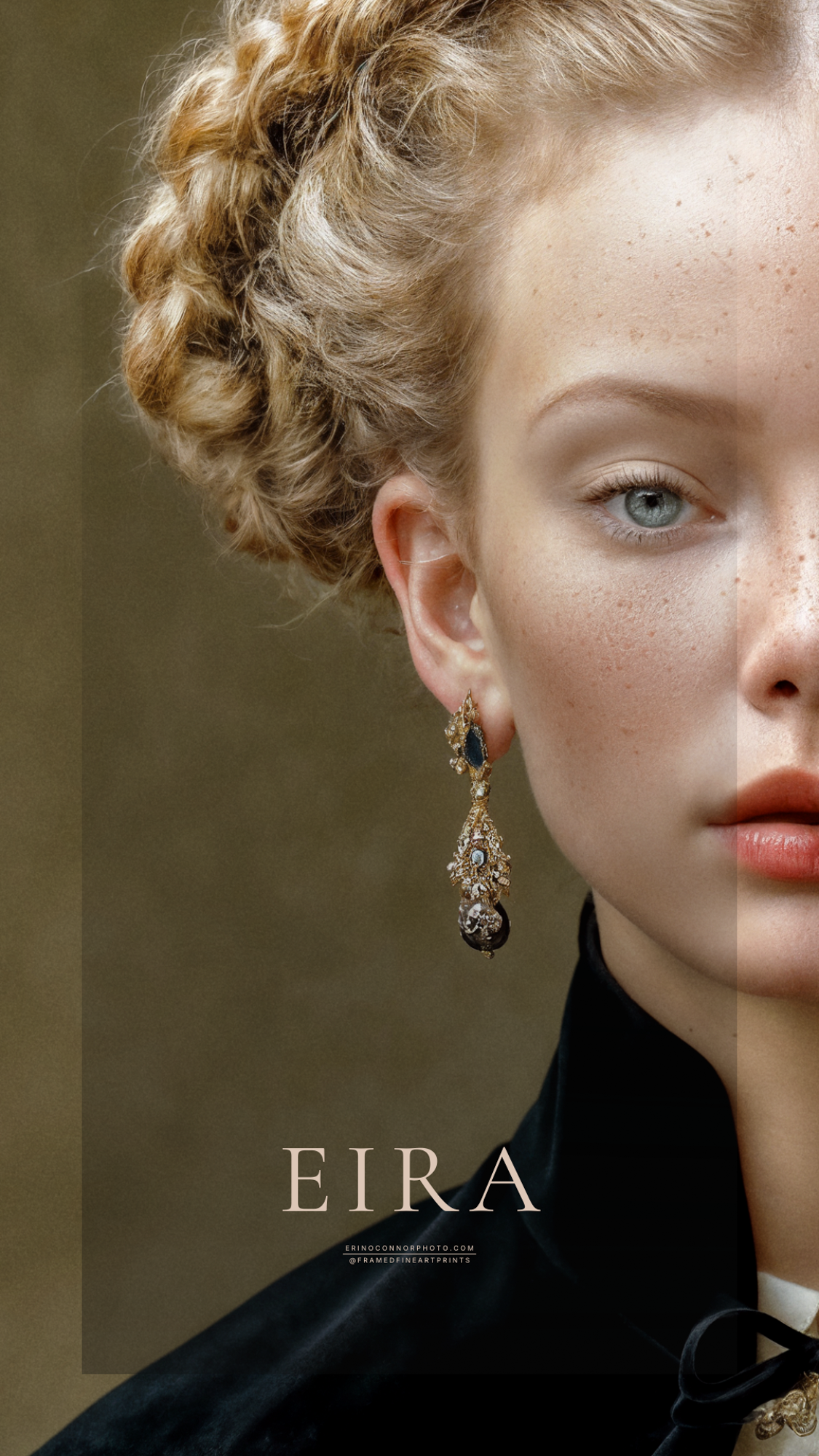
EIRA
A story of the courage to remain gentle.
01 · THE STORY
On the morning Eira was crowned, a rabbit was found beneath the throne.
The room had been empty the night before.
This everyone agreed upon.
The doors had been locked, the carpets swept, the candles counted and the crown placed beneath its glass.
Yet just after sunrise, one of the attendants heard something moving behind the carved wood of the dais.
When they looked, they found a rabbit.
It was pressed into the smallest shadow it could find, trembling so violently that its ears shook.
No one knew how it had entered.
The master of ceremonies called it an inconvenience.
One of the older councillors called it an omen.
A servant was sent to remove it.
Eira stopped him.
She was already dressed for the ceremony, though the crown had not yet been placed upon her head. The black velvet mantle fell heavily from her shoulders, and beneath it the ivory gown had been embroidered with the symbols of women who had worn it before her.
She knelt.
The rabbit did not run.
Perhaps it was too frightened.
Perhaps there was nowhere left to go.
Eira slid one hand beneath its body and lifted it against her dress. Its heart beat so quickly beneath her palm that for a moment she could distinguish it from her own.
“Where will you take it?” she asked.
The servant looked toward the master of ceremonies.
No one answered.
The palace gardens were enclosed. Beyond them were the hunting grounds. Traps had been set that week to prepare the estate for the coronation guests.
Eira looked down at the animal.
It had escaped one danger only to arrive at the center of another.
The bells began.
There was no longer time to decide what to do with it.
So Eira carried the rabbit into the throne room.
There were objections.
Not loud ones.
No one raised his voice to a woman minutes away from becoming sovereign.
But traditions had accumulated around the ceremony for centuries, and nowhere in them was there provision for a rabbit.
Eira listened to every objection.
Then she sat down.
The rabbit remained in her arms.
The crown was placed upon her head.
And the ceremony continued.
Later that afternoon, when the court painter arrived to begin the official portrait, he arranged beside Eira the objects traditionally used to represent authority.
A book.
A ceremonial blade.
The seal of office.
Eira looked at them for some time.
Then she asked for the rabbit.
The painter thought she was joking.
She was not.
He explained that rulers were generally portrayed with objects that communicated strength.
Eira asked him what strength meant.
He began to answer.
She interrupted him.
“Not what it looks like,” she said.
“What is it for?”
The painter had no answer.
Neither did the councillors standing behind him.
Eira placed the rabbit in her lap.
Gentleness was not the opposite of power. It was the measure of what power chose not to harm.
The portrait took several months to complete.
By then, the rabbit had been released beyond the palace gardens.
Eira never gave it a name.
When asked why, she said that naming something made it too easy to imagine it belonged to you.
The finished portrait disappointed several members of the court.
There was no sword.
No sceptre.
No open book displaying a lineage or law.
Only a young woman beneath an elaborate crown, wrapped in black velvet, holding an animal that seemed too vulnerable to belong in a royal portrait.
Years passed.
Visitors began asking about it.
Some assumed the rabbit had been a beloved pet.
Others decided it represented fertility or good fortune.
One historian argued that it must refer to an obscure family emblem.
Eira corrected none of them.
She once said that an image became less interesting when its owner insisted on explaining everything.
But among her private papers, one sentence was later discovered in a margin beside an inventory of the royal collection:
Let them remember what was in my hands, not what was on my head.
02 · BEHIND THE PORTRAIT
Power is revealed by what it chooses to protect.
At the center of Eira is a contradiction.
Everything about her appearance communicates authority. She wears a crown, an elaborate ceremonial gown and a black mantle whose visual weight nearly surrounds her.
Yet the object at the center of the portrait is neither a weapon nor an emblem of rule.
It is something vulnerable.
The rabbit changes the meaning of everything around it.
Without the animal, Eira might simply appear regal. With it, the portrait asks what authority is actually for.
The story deliberately avoids presenting gentleness as weakness. Eira does not reject her crown, her inheritance or the responsibility placed upon her. She accepts all three.
What she rejects is the idea that power must prove itself through domination.
The rabbit is frightened because it understands danger. Its vulnerability does not make it lesser; it makes the consequences of Eira's choices visible.
Her hands therefore become as important as her crown.
One represents the authority she has been given.
The other reveals what she intends to do with it.
The portrait asks a deceptively simple question:
If power cannot make the vulnerable safer, what is its purpose?
The crown tells us what Eira possesses.
Her hands tell us who she is.
03 · SYMBOLS IN THE WORK
Details that carry the story.
Eira's portrait is built around contrasts: hard and soft, dark and light, ceremonial and living. Each element changes meaning through its relationship to the others.
The Crown
The crown is the most obvious symbol of authority in the portrait, yet the story deliberately refuses to make it the emotional center.
It represents inherited power: something Eira receives rather than something she creates.
Its elaborate structure contrasts with the simplicity of the rabbit. One has been made precious through materials, craftsmanship and tradition.
The other is valuable simply because it is alive.
The portrait asks the viewer to consider which of those forms of value ultimately carries more responsibility.
The Rabbit
The rabbit represents vulnerability, but not helplessness.
Rabbits survive through sensitivity: listening, watching and responding quickly to danger. Traits that can be mistaken for fearfulness are also forms of perception.
Within Eira's story, the rabbit makes power accountable. It is the living thing against which authority can be measured.
Its presence asks whether strength is demonstrated by one's ability to dominate something weaker - or by choosing not to.
Black Velvet
Eira's black mantle represents the weight of office.
It is visually imposing, nearly swallowing the lighter gown beneath it, and gives her small figure an architectural presence.
Black traditionally carries associations with authority, solemnity and restraint. Here it also suggests the burden that accompanies power.
The mantle makes Eira appear larger.
The rabbit reminds us that appearing powerful and using power wisely are not the same thing.
Her Hands
Eira's hands are the quiet center of the portrait.
They do not restrain the rabbit. They create a boundary around it.
One hand supports its body while the other rests lightly across its back, producing a gesture that is protective without appearing possessive.
That distinction connects Eira subtly to the larger mythology of The Portrait Archive: care does not always require ownership.
Her authority is represented above her head.
Her character is revealed in what she does with her hands.
04 · WHAT REMAINS UNSAID
Decades after Eira's death, the portrait was removed from its frame for restoration.
Beneath the painted rabbit, conservators discovered the outline of another object.
A sword.
No surviving record explains who ordered it painted over.
AVAILABLE TO COLLECT
Bring Eira Home
An image of authority, vulnerability and the quiet strength of choosing to protect.
Eira is available as a fine-art print and in a selection of professionally framed presentations. Her restrained palette of black, ivory, muted olive and antique gold gives the portrait the presence of an old-master painting while remaining particularly striking in contemporary, traditional and darkly layered interiors.
About the Artwork
Eira is an original digitally created fine-art portrait developed through an artist-directed process combining generative imagery with extensive digital editing, compositing and retouching.
My approach is informed by decades of experience in photography and digital retouching, as well as my background as an art curator and my MA from the School of the Art Institute of Chicago. The work draws from the visual language of photography while embracing the atmosphere, texture and material qualities traditionally associated with painting.
Rather than using digital technology as an end in itself, I use it as one part of a larger artistic process - shaping composition, color, texture, gesture and narrative until each portrait feels like a fully realized work with a world of its own.
Eira is part of The Portrait Archive, an ongoing collection in which each portrait is accompanied by an original story exploring the ideas, symbols and unanswered questions contained within the image.
THE PORTRAIT ARCHIVE
Every portrait begins with a woman. But it does not end with her image. Enter each story to discover the memories, symbols and unanswered questions that live beyond the frame.